



Residential solar-plus-storage installations require a hybrid inverter to manage the flow of energy between solar panels, batteries, the utility grid, and household loads. The type of hybrid inverter selected can determine the extent of electrical modifications needed at the home, directly affecting both the cost and timeline of a project.
A hybrid inverter with 200A grid passthrough capability, for example, can be installed between the utility meter and the existing main panel without requiring a main panel upgrade. This article explains how this capability works and why it matters for residential solar-plus-storage installations.

How Are Hybrid Inverters Conventionally Connected to Electrical Systems
In a conventional setup, the hybrid inverter feeds power into the home’s main service panel through its own dedicated backfeed breaker. This means the panel’s busbar carries current from two sources simultaneously: the utility grid flowing through the main breaker, and the inverter output flowing through the backfeed breaker. Because these two currents overlap on the same busbar, the National Electrical Code places limits on how large the backfeed breaker can be.
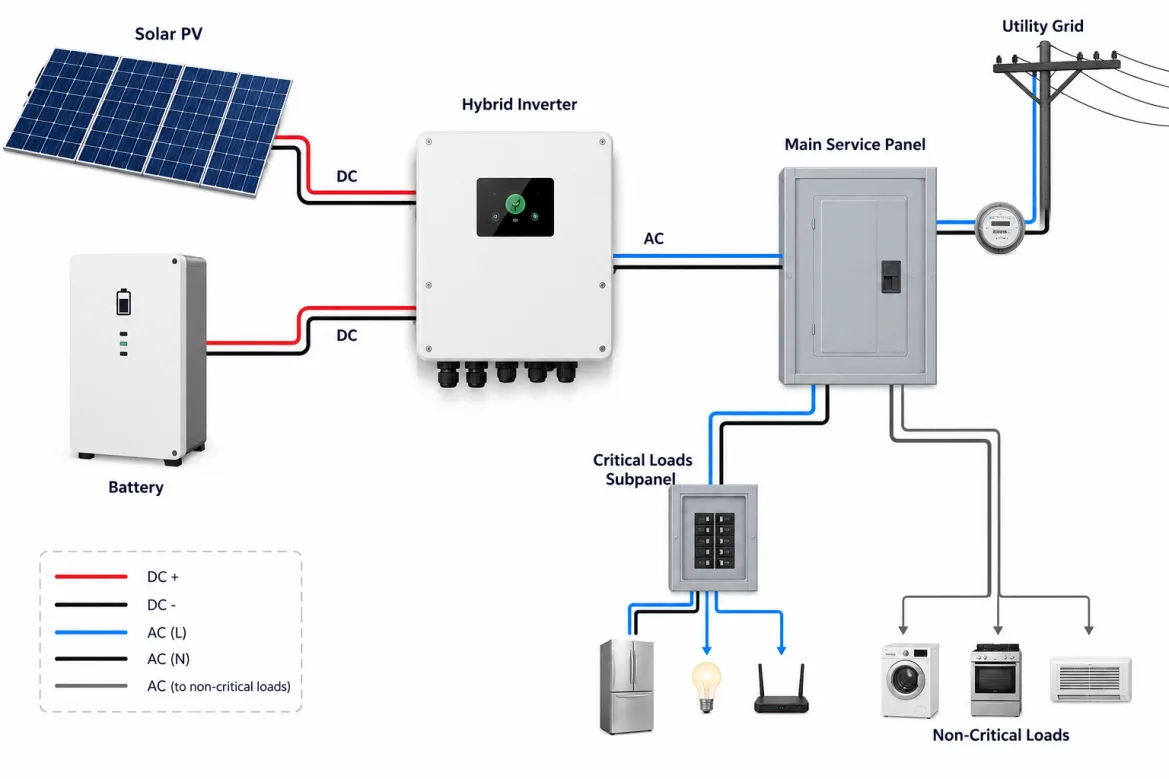
The most commonly applied limit is the NEC 120% rule under Section 705.12(B)(3). It requires that the sum of the main breaker rating and the backfeed breaker rating must not exceed 120% of the busbar’s rated ampacity.
For example, in a 200A residential panel, which is the most common configuration in U.S. and Canadian homes, the calculation is: 200A × 120% = 240A, minus the 200A main breaker, leaving a maximum allowable backfeed breaker size of 40A. This means the inverter can feed at most 40A of solar and battery power back to the panel busbar.
A 10 kW solar-plus-storage system has a rated output current of approximately 42A at 240V, and a 15 kW system reaches approximately 63A. To utilize the full output of these larger systems, the homeowner must either derate the main breaker or perform a full main panel upgrade (MPU).
However, an MPU is a significant expense. In North America, it typically costs between $2,500 and $5,000 or more. In addition, the process involves utility coordination, permits, inspections, and sometimes rewiring the service entrance, adding weeks or even months to a project timeline. For installers, extended timelines lead to higher soft costs and reduced margins. For homeowners, it means greater expense and a longer wait.
Moreover, the conventional inverter architecture limits backup coverage. During a grid outage, the inverter must only power circuits that have been pre-wired to a separate critical loads subpanel to ensure anti-islanding protection. Setting up this subpanel requires electricians to identify and physically relocate individual circuits from the main panel, which increases installation time.
What About Hybrid Inverters with 200A Grid Passthrough Capability
Instead of tapping into the main panel as one of two sources on the busbar, a hybrid inverter with grid passthrough capability can be installed in series between the utility meter and the main panel.
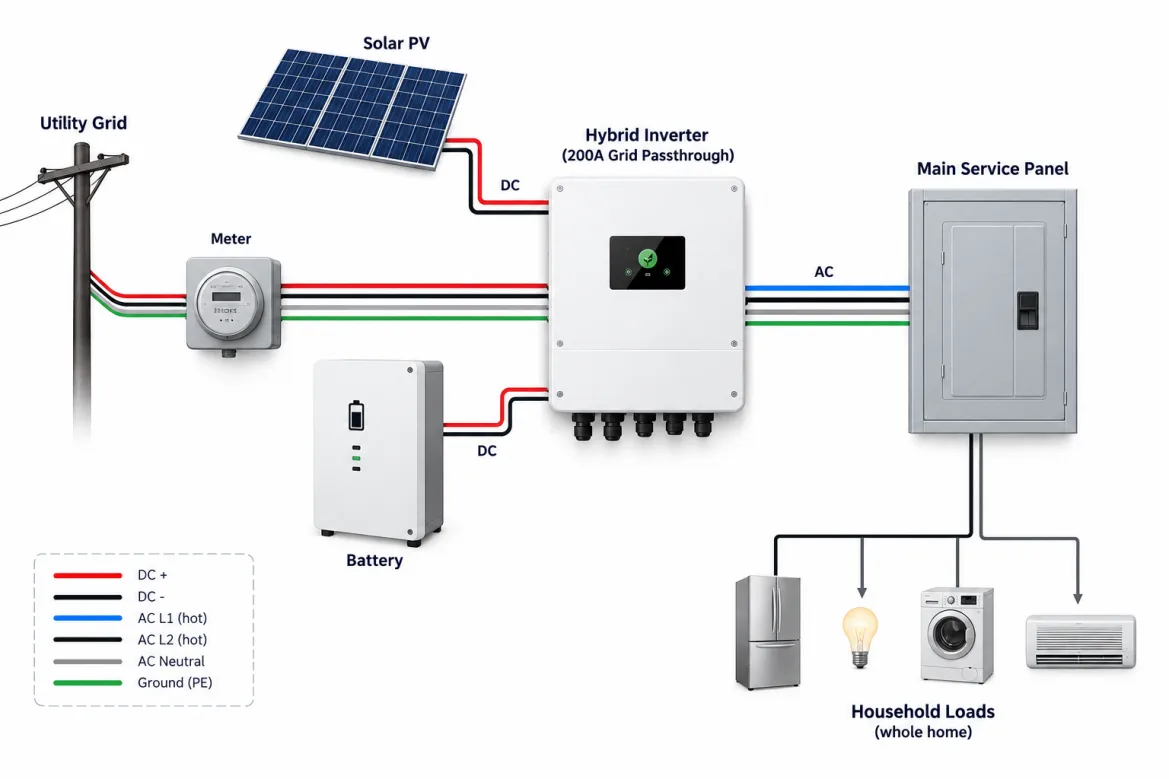
When the grid is live, utility power passes through the hybrid inverter’s bypass relay to the main panel. The inverter’s control algorithm dynamically manages the inverter’s output (solar and battery power), adjusting it based on battery state of charge, solar irradiance, and household load.
When a grid outage is detected, the automatic transfer switch (ATS) disconnects from the utility within milliseconds. The inverter then forms an independent microgrid using the home’s existing main panel as the distribution point.
Since the busbar is fed only by the inverter’s output breaker, the NEC’s 120% rule—which specifically addresses the combined loading of two simultaneous sources on one busbar—doesn’t apply here. Instead, the panelboard only needs to satisfy the standard requirement that the output breaker’s rating not exceed the busbar’s rating.
As a result, homeowners are not limited by the available busbar capacity of the existing panel. The solar and battery system can be sized based on actual energy needs, allowing for more solar capacity, battery storage, or use of available roof space. This also means a main panel upgrade (MPU) is no longer a prerequisite for installing a system of that size.
Kayis Series: A Split-Phase Hybrid Inverter with Optional 200A Bypass
The Kayis Series from Ktech Energy is a line of split-phase hybrid inverters (models KE-7K/7K5/8K/10K/12KD6LSUN, covering 7 kW to 12 kW) designed for the North American grid.
The Kayis Series offers an optional 200A bypass current path (grid to load). The inverter natively outputs split-phase 120V/240V (2L+N+PE) power. It provides balanced power delivery that is compatible with standard North American appliances and panel configurations.
The Kayis Series supports on-grid and off-grid operation, up to 10-unit parallel connection for system expansion, and VPP (Virtual Power Plant) compatibility. It also includes built-in AFCI, GFCI, and RSD protection, offers WiFi/Bluetooth/4G communication options, and carries an IP66 ingress protection rating with UL1741 and IEEE 1547 certification.
Its built-in load management features allow the inverter to dynamically shed non-essential high-power loads during islanding, helping protect the battery from excessive discharge while maintaining power to critical circuits.
Conclusion
In short, a hybrid inverter with 200A grid passthrough capability can simplify residential solar-plus-storage installations. By placing the inverter between the utility meter and main panel, it can reduce the need for a main panel upgrade while supporting larger solar and battery systems and whole-home backup.
The Ktech Energy Kayis Series, with its native split-phase output and optional 200A bypass capability in a single integrated package, is one example of how this capability is being implemented in products available for the North American market.



