


For installers and procurement teams, the inverter is the component that most directly determines whether a solar project performs as promised. A wrong choice rarely shows up at the quotation stage. It appears later, as rework on site, delayed commissioning, customer complaints, or unsold stock that ties up working capital.
Many of these problems come from the same root cause: the inverter type does not match the real conditions of the project. An on-grid inverter installed where the customer expects backup power, or a hybrid inverter specified where no battery will ever be added, both reduce profit and damage trust. This article explains the differences between the three main inverter types and shows how to match each one to the right project, so that selection errors can be avoided.
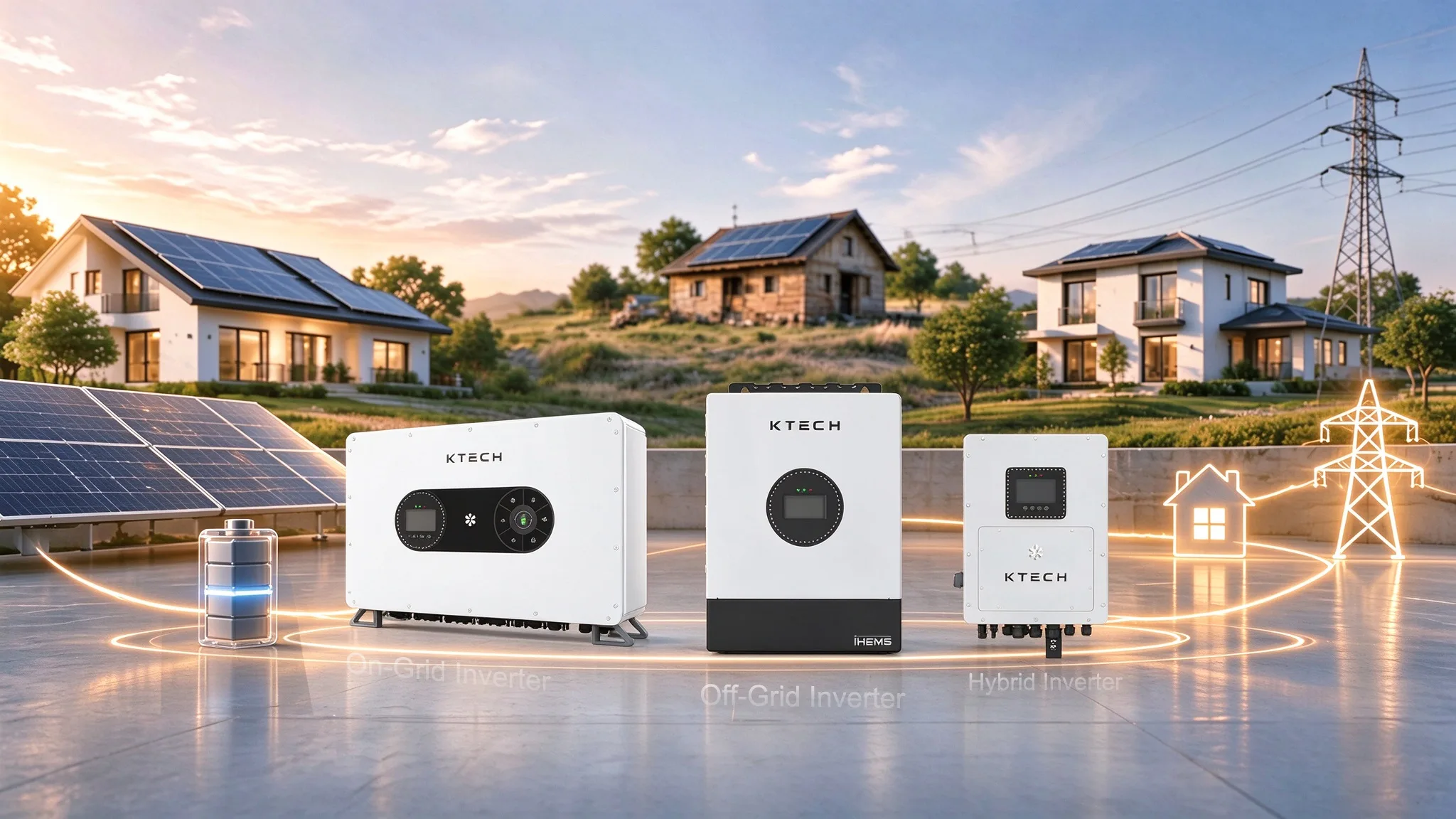
Three Inverter Types at a Glance
An on-grid inverter converts the direct current from solar panels into alternating current and feeds it into the utility grid. It has no battery function. For safety reasons, it shuts down automatically when the grid fails, which means a system with an on-grid inverter provides no power during an outage.
An off-grid inverter operates independently from the utility grid. It draws power from a battery bank, which is charged by solar panels or, in some cases, a generator. It supplies the loads directly and is designed for sites where grid connection is unavailable or unreliable.
A hybrid inverter combines both functions. It can connect to the grid, charge and discharge a battery, and supply backup power when the grid is down. It can also switch between grid-tied and off-grid operation, depending on the settings and site conditions.
| On-Grid Inverter | Off-Grid Inverter | Hybrid Inverter | |
| Grid Connection | Required | Not used | Supported |
| Battery Connection | Not supported | Required | Supported |
| Backup Power during Outage | No | Yes | Yes |
| Installation Complexity | Low | Medium to high | Medium to high |
| Typical Cost Level | Lowest | Medium | Highest |
Which Inverter Fits Which Type of Project?
The right inverter depends mainly on three things: the quality of the local grid, the customer’s need for backup power, and whether storage will be added now or later. The four project types below cover most of the cases that installers and buyers meet in practice.
Stable Grid, Focus on Lower Electricity Bills
When the grid is reliable and the customer’s main goal is to reduce electricity costs, an on-grid inverter is usually the most economical choice. Residential and commercial rooftop projects in areas with stable power supply and good feed-in or net metering policies fall into this group. Adding a battery would raise the system cost without delivering a clear return, so a hybrid inverter is often unnecessary here.
No Grid or an Unreliable Grid
For remote farms, telecom stations, mining camps, and rural electrification projects, an off-grid inverter is the standard solution. In these cases, the system must supply power on its own every day. Installers should pay close attention to battery capacity, load profile, and the starting current of motors and pumps, since these factors determine whether the system runs reliably.
Large Price Differences Between Peak and Off-Peak Hours, or a Backup Power Requirement
In regions with time-of-use tariffs, a hybrid inverter allows the system to store surplus solar energy and use it when electricity prices are high. It also provides backup power during outages, which is a growing requirement for homes and small businesses. For these projects, the additional cost of a hybrid inverter is often justified by the value of energy shifting and power security.
Customers Who May Add Batteries Later
Some customers do not want to invest in storage today but expect to do so in the future. In this situation, a hybrid inverter or a battery-ready model avoids the need to replace the inverter later. Installers can quote a lower initial price by leaving out the battery, while keeping the upgrade path open.
What Should You Check Before Placing an Order?
Choosing the right type is only the first step. Before placing an order, installers and buyers should confirm the following points.
- Grid codes and certification.Local grid connection standards, certification requirements, and any limits on power export vary between markets. An inverter that does not meet local requirements may be rejected by the utility, even if it performs well technically.
- Load requirements.For backup and off-grid projects, the rated power of the inverter must cover both the continuous load and the surge current of equipment such as air conditioners, compressors, and water pumps.
- Battery compatibility. The battery voltage range, chemistry, and communication protocol must match the inverter. Compatibility problems are a common cause of delays during commissioning.
- Phase configuration and power matching.Single-phase and three-phase inverters suit different sites. The ratio between PV capacity and inverter rating also affects both energy yield and system cost.
- If the project may expand, check whether the inverter supports parallel operation and how many units can be connected together.
Why Source All Three Inverter Types from One Supplier?
Projects differ from one another, and so does the inverter each one needs. Installers and distributors who serve several types of customers often find themselves working with multiple suppliers, each with different technical support, delivery schedules, and after-sales processes.
At Ktech Energy, we offer on-grid, off-grid, and hybrid inverters. A rooftop project aimed at lowering electricity bills, a remote site with no grid access, and a home that needs backup power can all be served by the same supplier. This matches the project types described earlier in this article.
For procurement teams, the benefits are practical. Working with a single supplier means one technical team to consult, one set of terms to manage, and a consistent standard for service and support. Orders for different project types can be combined, which simplifies logistics and reduces the effort of managing inventory across several brands. For installers, familiarity with one product family shortens training time and reduces the risk of installation errors.
Conclusion
Choosing between a hybrid, off-grid, and on-grid inverter does not have to be complicated. A sound approach is to start with the grid conditions and the customer’s backup power needs, and then consider whether storage is required now or may be added later. On-grid inverters suit stable-grid projects focused on lower bills. Off-grid inverters serve sites with no reliable grid. Hybrid inverters fit projects that need backup power, energy shifting, or room for future expansion.
By confirming these points before ordering, installers and buyers can reduce rework, protect project margins, and deliver systems that meet customer expectations. For projects that call for different inverter types, Ktech’s complete product range and technical support can simplify the process. Contact the Ktech team for product information and quotations.



